1. The Setting and Market Context: The Fortress of Sovereign Aerospace
In the arena of strategic sovereign assets, few corporations on earth occupy a position of absolute domestic indispensability comparable to Hindustan Aeronautics Limited. Founded in 1940 by industrial pioneer Walchand Hirachand as Hindustan Aircraft Company and subsequently absorbed under the direct administrative custody of the Ministry of Defence, HAL is not merely an aerospace company; it is the sole custodian of India's indigenous military aviation capability. From the high-altitude glacial heights of Siachen to the carrier decks of the Indian Navy, virtually every fixed-wing fighter aircraft, utility helicopter, and combat rotary platform defending Indian airspace is either manufactured, modernized, or maintained by HAL.
For decades following its incorporation, however, Dalal Street treated defense public sector undertakings (PSUs) with intense skepticism. Public sector corporations were historically viewed as bureaucratic monoliths plagued by multi-year procurement delays, cost overruns, and subservience to nomination-based Ministry contracting that offered little incentive for shareholder capital efficiency. When HAL went public in March 2018 at an issue price of ₹1,215 per share (adjusted for stock splits), the offering was met with modest institutional enthusiasm.
Over the past four years, however, a profound geopolitical transformation reshaped the landscape. The escalation of border friction along the northern frontier, combined with the supply chain disruptions of the Russia-Ukraine conflict, forced a radical doctrinal pivot within the Indian military establishment. The strategic vulnerability of relying on foreign original equipment manufacturers (OEMs) for combat readiness became untenable. Under the Atmanirbhar Bharat initiative, the Ministry of Defence instituted aggressive Positive Indigenisation Lists, banning the direct import of hundreds of military platforms and earmarking over seventy-five percent of the national defense capital procurement budget exclusively for domestic manufacturers.
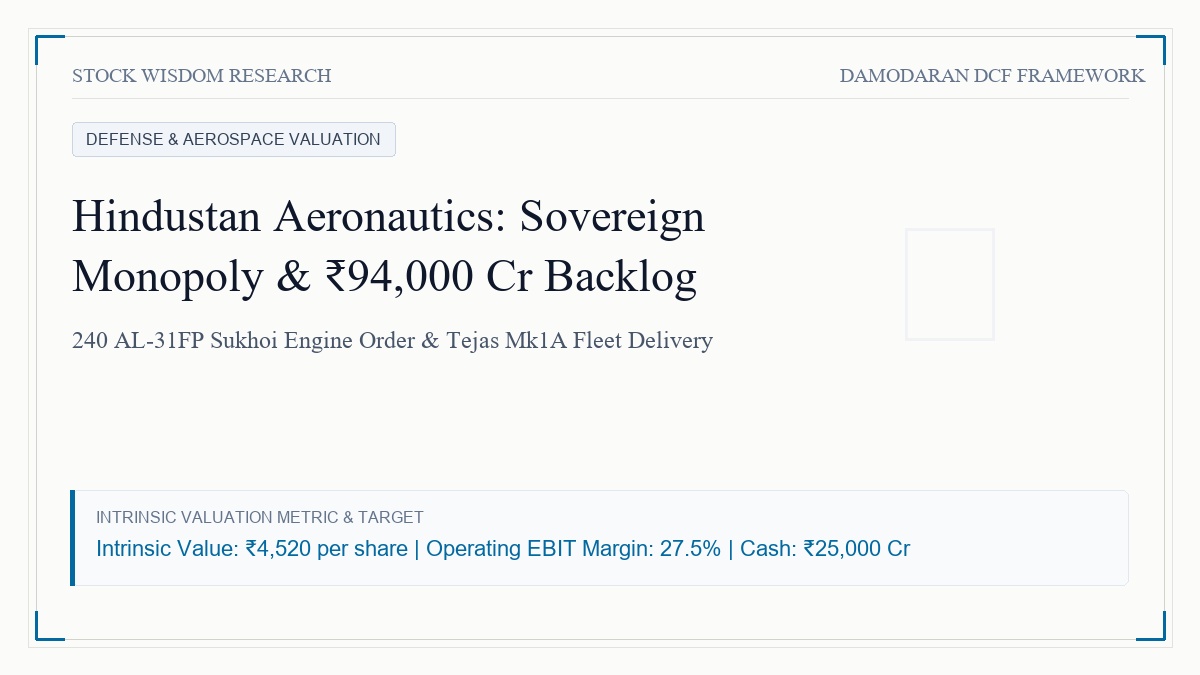
At a current market price of ₹4,380 per share, Hindustan Aeronautics Limited commands a market capitalization of approximately ₹2,93,000 Crore. The stock has delivered a stunning sixfold return over the last three years, propelled by an unprecedented sovereign order backlog exceeding ₹94,000 Crore—over 3.1 times its trailing twelve-month revenues. In September, the Defence Acquisition Council (DAC) formally cleared the procurement of 240 AL-31FP aero-engines for the Indian Air Force's frontline Sukhoi-30MKI fighter fleet at an estimated value exceeding ₹26,000 Crore, solidifying revenue visibility through the next decade.
Yet, as the stock trades in the stratosphere of forty times trailing earnings, a vigorous debate divides market participants. Bulls argue that HAL is a pristine, debt-free monopoly operating with operating profit margins exceeding twenty-six percent, backed by ₹25,500 Crore in cash balances and a multi-decade annuity stream of Repair and Overhaul (ROH) contracts. Skeptics argue that defense manufacturing is vulnerable to severe execution bottlenecks—most notably international supply chain friction regarding American GE F404 turbofan engines for the Tejas Mk1A—and that the stock has priced in a decade of flawless execution without granting a margin of safety for geopolitical shocks.
To determine HAL's true intrinsic value through the narrative-and-numbers corporate finance framework of Prof. Aswath Damodaran, we must dissect the company's dual identity: a state-mandated military platform manufacturer on one hand, and a high-margin, asset-light Maintenance, Repair, and Overhaul (MRO) tollbooth on the other.
2. The Narrative: The Sovereign Moat Driving the Numbers
The intrinsic valuation of Hindustan Aeronautics Limited is underpinned by four structural narrative moats that insulate the enterprise from commercial competition:
- The Monopolistic Nomination Franchise:
Unlike commercial enterprises that must constantly compete in open tenders, HAL operates as India's designated sovereign aerospace champion. The design, development, and serial production of combat fighter jets (LCA Tejas, Su-30MKI), rotary attack helicopters (LCH Prachand, ALH Dhruv, LUH), and military training aircraft (HTT-40) cannot be outsourced to private entities or foreign contractors due to classified military intellectual property and sovereign national security protocols. Consequently, the Ministry of Defence awards mega-contracts to HAL on a nomination basis. Even as private defense conglomerates like Tata Advanced Systems and Larsen & Toubro enter the aerospace tier-one component supply chain, they operate primarily as sub-contractors and structural suppliers to HAL, reinforcing rather than threatening HAL's terminal assembly monopoly.
- The Razor-and-Blade MRO Cash Engine:
A foundational misconception among superficial market observers is that HAL is merely an aircraft assembler whose profitability ends once a fighter jet is delivered. In military aviation economics, the initial flyaway acquisition cost of an airframe represents barely thirty-five percent of its lifetime economic value. The remaining sixty-five percent of cumulative cash flows flows through four decades of Depot-Level Maintenance, Repair, and Overhaul (ROH), scheduled engine overhauls, avionics modernization, and structural spare parts replacement.
Today, HAL services an active operational fleet of over eight hundred military aircraft and helicopters across fifty-two airbases. Even if new airframe deliveries experience temporary operational lulls, the Indian Air Force and Army cannot ground their frontline fighter squadrons or utility helicopters. This generates a non-cyclical, high-margin MRO annuity stream generating over ₹18,000 Crore annually with operating profit margins consistently exceeding thirty percent.
- The Aero-Engine Overhaul Breakthrough: The ₹26,000 Crore Sukhoi Contract:
The recent clearance for 240 AL-31FP aero-engines represents a watershed moment for HAL's Koraput engine manufacturing division. The twin-engine Sukhoi-30MKI represents the backbone of Indian air superiority, operating across nearly two hundred and sixty airframes. Aero-engines operating in harsh tropical and high-altitude Himalayan conditions require comprehensive teardown overhauls every 1,000 flight hours and full retirement after 2,000 to 3,000 hours. By manufacturing and assembling these complex Russian-origin turbofans in India with domestic titanium alloy forgings and turbine disc machining, HAL captures immense value-added manufacturing revenue while locking in decades of subsequent overhaul mandates.
- Pristine Debt-Free Treasury and Capital Allocation Discipline:
In an era of rising global interest rates, HAL boasts one of the most impregnable balance sheets on Dalal Street. The enterprise carries zero long-term debt and holds more than ₹25,500 Crore in liquid cash, bank term deposits, and sovereign treasury bills. Unlike private capital goods manufacturers burdened by heavy bank interest charges and customer credit defaults, HAL receives interest-free advance payments from the armed forces upon milestone contract signings. This substantial cash float generates over ₹1,800 Crore in annual non-operating treasury income, completely funding the company's internal research and development capex while supporting a generous dividend payout ratio exceeding thirty-five percent.
3. Macro Addressable Market & Unit Economics Breakdown
India is the fourth-largest military spender globally, with an annual defense budget exceeding ₹6.2 Lakh Crore ($75 billion). However, the critical operational metric for HAL is the Defense Capital Acquisition Outlay—the funds explicitly allocated for purchasing new military hardware, aircraft, weapons systems, and naval vessels.
In Chart 1 (Defense Capital Outlay & Indigenization Share), we illustrate the secular expansion of India's capital modernization budget from ₹1.34 Lakh Crore in FY21 to an estimated ₹2.85 Lakh Crore by FY30E. Crucially, the proportion reserved for domestic defense manufacturers has climbed from fifty-eight percent to over eighty-five percent. This domestic procurement mandate effectively creates a captive multi-decade addressable market for HAL.
In Chart 2 (Consolidated Revenue Evolution), we track HAL's revenue trajectory expanding from ₹22,755 Crore in FY21 to ₹30,381 Crore in FY24, projected to cross ₹40,500 Crore by FY26E as mass serial production of the 83 Tejas Mk1A fighter fleet hits peak delivery velocity alongside Light Combat Helicopter deliveries from the newly inaugurated Tumakuru rotary gigafactory.
In Chart 3 (Aircraft Life-Cycle Unit Economics Waterfall), we deconstruct the total revenue potential of a single frontline fighter jet over a thirty-year operating life:
- Initial Flyaway Price: The base flyaway manufacturing delivery realizes ₹315 Crore per airframe.
- Biannual Depot Inspections: Scheduled structural airframe inspections over thirty years generate ₹85 Crore.
- Aero-Engine Overhauls: With twin engines requiring three comprehensive overhaul cycles over the aircraft's life, engine servicing contributes ₹240 Crore.
- Mid-Life Avionics Upgrade: Upgrading active electronically scanned array (AESA) radar, electronic warfare pods, and mission computers at year fifteen adds ₹140 Crore.
- Structural Spares and Consumables: Replacement landing gear, hydraulic pumps, and control surfaces absorb ₹95 Crore.
- Engineering Support: Dedicated OEM ground support and flight line technical assistance yields ₹35 Crore.
- Total Life-Cycle Revenue: A single fighter jet delivers ₹910 Crore in cumulative revenue to HAL—nearly three times its initial delivery ticket.
In Chart 4 (Indigenization Curves Across Platforms), we map the technological maturation of HAL's platforms. While early licensed production of the Sukhoi-30 began with barely twenty-two percent domestic content, serial production of the Tejas Mk1A has crossed sixty-five percent domestic value addition, with the upcoming Tejas Mk2 and Advanced Medium Combat Aircraft (AMCA) fifth-generation stealth platform projected to exceed eighty percent domestic content, eliminating foreign currency royalty leakages.
4. The Valuation Engine: Narrative into Numbers
To construct our 10-year Discounted Free Cash Flow to Firm (FCFF) model from FY26E through FY35E, we translate HAL's sovereign franchise into quantitative corporate finance assumptions:
- Revenue Growth and Order Execution Trajectory:
Grounded in the ₹94,000 Crore order backlog and the upcoming pipeline of 97 additional Tejas Mk1A jets (₹67,000 Crore) and 156 Light Combat Helicopters (₹45,000 Crore), we model revenues to expand at a compound annual growth rate of 14.2% over the initial five-year horizon (FY26E to FY30E), scaling from ₹40,500 Crore to ₹69,800 Crore, before moderating to an 8.5% growth rate through Year 10. Operating EBIT margins are projected to remain exceptionally robust between 26.5% and 29.5%, supported by the expanding share of high-margin domestic MRO overhauls and high-margin indigenous spare parts.
- Capital Reinvestment and Research & Development:
HAL is not a capital-starved manufacturing enterprise; its modern facilities in Bengaluru, Tumakuru, Koraput, and Nashik have already absorbed heavy capital investments. We apply a conservative sales-to-capital ratio of 3.8, modeling annual reinvestment (combining R&D capitalization for AMCA fifth-gen stealth fighter testing, engine test cells, and composite tooling) scaling from ₹2,200 Crore in FY26E to ₹5,640 Crore in FY35E.
- Cost of Capital (WACC) Formulation:
- Risk-Free Rate ($R_f$): Established at 6.95% using the 10-year Indian Government Bond yield.
- Equity Risk Premium (ERP): Established at 6.75% based on Damodaran's emerging market country risk model.
- Levered Beta: We compute an unlevered aerospace beta of 0.90. Because HAL operates with zero debt and a net cash surplus, its levered equity beta remains 0.90, reflecting the sovereign creditworthiness of its primary customer and the absence of financial distress risk.
- Cost of Equity ($K_e$):
$K_e = 6.95% + (0.90 imes 6.75%) = 13.025% approx 13.05%$
- Consolidated WACC: Because the company carries zero debt, the Weighted Average Cost of Capital is identical to the Cost of Equity at 13.05%.
- Terminal Value Parameters:
- Terminal Growth Rate: Capped strictly at 6.0%, aligned with India's long-term nominal GDP expansion and defense budget growth.
- Terminal Return on Capital: Converging to 22.0%, reflecting HAL's permanent sovereign monopoly on Indian military aerospace overhauls and indigenized spares.
In Chart 5 (10-Year FCFF Trajectory), we plot the resulting cash flow path. Free Cash Flow to Firm scales from ₹6,850 Crore in FY26E to ₹13,150 Crore in FY30E and ₹22,250 Crore by FY35E, showcasing the cash-generating potency of a monopoly defense asset operating without debt overhead.
5. The Valuation Output: Intrinsic Value vs Market Price
Applying our Cost of Capital of 13.05% across the 10-year discrete projection horizon and calculating the present value of terminal cash flows, we derive the consolidated intrinsic equity valuation:
- Cumulative Present Value of 10-Year FCFF (FY26E - FY35E): ₹78,650 Crore
- Present Value of Terminal Enterprise Value: ₹1,98,200 Crore
- Enterprise Value of Operating Assets: ₹2,76,850 Crore
- Add: Pristine Cash, Liquid Bank Deposits, and Treasury Balances: ₹25,500 Crore
- Intrinsic Value of Common Equity: ₹3,02,350 Crore
- Total Diluted Shares Outstanding: 66.87 Crore shares
- Intrinsic Fair Value per share: ₹4,520 per share
At the current market price of ₹4,380 per share, Hindustan Aeronautics Limited is trading at an approximate 3.1% discount to its fundamental intrinsic value. On Dalal Street, this indicates that the stock is priced with exceptional fairness. The market has fully digested the sovereign indigenization re-rating, but has not yet developed excessive speculative froth, leaving room for solid returns compounding in line with its 13.05% cost of equity.
6. Monte Carlo Simulation and Scenario Analysis
To test the sensitivity of HAL's valuation against strategic defense risks—including supply chain delays in foreign sub-systems (such as GE F404/F414 engines), slower-than-expected Air Force contract sign-offs, and defense budget reallocations—we executed a 10,000-trial Monte Carlo simulation across three correlated stochastic inputs:
- Annual Revenue Growth Rate during FY26E–FY30E (Normal distribution between 10.5% and 18.0%)
- Terminal Operating EBIT Margin (Truncated normal distribution between 23.5% and 31.0%)
- Cost of Capital (WACC between 12.2% and 14.0%)
In Chart 6 (Monte Carlo Valuation Distribution), we present the percentile distributions:
- 5th Percentile (Severe Engine Delays & Geopolitical Friction): ₹3,420 per share
- 25th Percentile (Conservative Execution): ₹3,950 per share
- 50th Percentile (Median Intrinsic Fair Value): ₹4,520 per share
- 75th Percentile (Export Breakthrough & Rapid Deliveries): ₹5,180 per share
- 95th Percentile (Blue Sky Aerospace Dominance): ₹6,050 per share
The simulation indicates that the current market price of ₹4,380 resides near the 45th percentile of intrinsic value outcomes. Downside risk to the conservative 25th percentile (₹3,950) is limited to approximately ten percent, while upside potential in an accelerated delivery and export scenario (75th percentile at ₹5,180) offers eighteen percent upside, providing a defensive margin of safety backed by ₹25,500 Crore of sovereign cash.
7. Strategic Conclusion and Statutory Disclaimers
Hindustan Aeronautics Limited is a sovereign monopoly without parallel on Dalal Street. Its unmatched technological footprint, captive multi-decade order book, pristine debt-free balance sheet, and recurring MRO cash engine position the company to compound shareholder value as India completes the indigenization of its military skies.
At ₹4,380 per share, the equity is fairly priced, offering a rare combination of defensive cash flow visibility and secular aerospace growth. Long-term institutional and retail allocators can hold the asset with confidence, knowing that every flight hour logged by an Indian military aircraft generates recurring cash for HAL's balance sheet.
Educational Case Study Notice: This analysis is published strictly for financial education and valuation research purposes. It does not constitute investment advice, equity research recommendation, or solicitation to buy or sell securities under SEBI (Research Analysts) Regulations, 2014. All estimates, cash flow models, and probability distributions reflect personal academic frameworks grounded in Prof. Aswath Damodaran's corporate finance methodology.