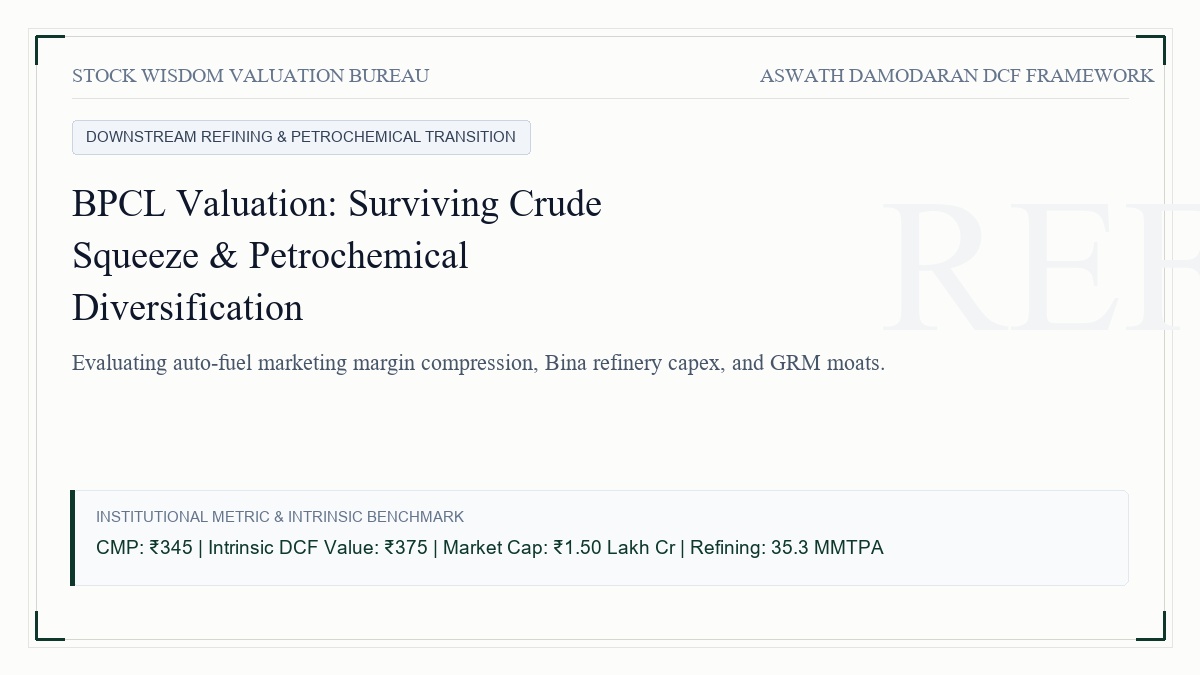
1. The Setting and Market Context: The Downstream Margin Crucible
When international crude benchmarks surge violently past $100 per barrel, as witnessed on Dalal Street following geopolitical escalations in the Middle East, the Indian energy sector fractures into two diametrically opposed financial realities. While upstream explorers rejoice over windfall revenues, downstream oil marketing companies (OMCs) enter what market veterans call the downstream margin crucible.
Bharat Petroleum Corporation Limited, trading under the ticker BPCL with a market capitalization of approximately ₹1,50,000 Crore following its 1:1 bonus share issuance, stands at the absolute epicenter of this cyclical tension. Operating three major refineries at Mumbai, Kochi, and Bina with a combined crude processing capacity of 35.3 million metric tonnes per annum (MMTPA), BPCL powers approximately twenty-five percent of India's retail transportation fuel distribution through an expansive national network of over 21,800 retail fuel outlets and 6,240 LPG distributorships.
The battle between the pricing game and the valuation game is nowhere more fierce than in the equity valuation of BPCL. Traders playing the pricing game fixate entirely on near-term spot auto-fuel marketing margins. With retail pump prices for petrol and diesel effectively frozen by informal government guidance to protect Indian consumers from imported inflation, a surge in feedstock crude costs to $101 per barrel crushes retail marketing margins, turning daily marketing profitability negative. When news outlets report OMC losses of ₹3 to ₹5 per liter on diesel, algorithmic trading desks aggressively dump OMC shares.
However, the valuation game, formulated upon Prof. Aswath Damodaran's narrative-and-numbers corporate finance discipline, requires investors to detach from daily pump price hysteria. Downstream oil refining and marketing is an inherently cyclical, integrated spread business. Refining margins (GRMs) typically widen during geopolitical disruptions as global product cracks (diesel and jet fuel spreads) expand. More importantly, periods of acute marketing under-recovery have historically proven temporary, followed by prolonged periods of soft crude where OMCs recoup losses by delaying pump price cuts.
To establish the authentic intrinsic value of Bharat Petroleum, we must model the entire integrated spread, evaluate the strategic moat of its retail real estate network, and assess the return on invested capital of Project Aspire—its ₹1,50,000 Crore five-year capital expenditure blueprint aimed at transforming BPCL from a pure fossil fuel refiner into an integrated petrochemical and green energy powerhouse.
2. The Narrative: Frozen Retail Fuel Tollbooths, Refining Arbitrage, and Project Aspire Petrochemicals
The valuation narrative of Bharat Petroleum Corporation Limited rests upon four core qualitative tenets that dictate its cash generation through energy cycles:
First, The Retail Tollbooth and Marketing Asymmetry: The true economic moat of BPCL is not its physical distillation towers, but its irreplaceable physical footprint of 21,800 retail fuel stations strategically distributed along national highways and prime urban real estate across India. Replicating this distribution network is virtually impossible for private competitors due to prohibitive land acquisition costs and regulatory zoning constraints. While government influence intermittently caps marketing margins during crude price spikes, this regulatory intervention is asymmetrical: the government inevitably permits marketing margin expansion once crude softens, enabling BPCL to maintain an average through-the-cycle marketing margin of ₹2.50 to ₹3.50 per liter.
Second, Refining Complexity and Distillate Yield Arbitrage: BPCL's refining assets are among the most technologically sophisticated in emerging Asia. The Integrated Refinery Expansion Project (IREP) at Kochi escalated the refinery's Nelson Complexity Index above 10.0, enabling it to process heavy, sour, high-sulfur crude grades purchased at significant discounts to light sweet Brent. This high complexity allows BPCL to maximize high-value middle distillates (diesel, kerosene, and aviation turbine fuel) while minimizing low-value fuel oil output. Consequently, BPCL consistently delivers Gross Refining Margins (GRMs) that command a $2.00 to $3.50 per barrel premium over the benchmark Singapore complex refining margin.
Third, The Petrochemical Pivot: Project Aspire and the Bina Ethylene Cracker: Historically, standalone refiners suffer from cyclical margin commoditization. To insulate operating cash flows from volatile fuel margins and prepare for long-term electric vehicle adoption, BPCL is executing Project Aspire, a monumental ₹1,50,000 Crore investment program over five years. The centerpiece of this transformation is the ₹49,000 Crore ethylene cracker project at the Bina refinery in Madhya Pradesh. By expanding Bina's refining capacity from 7.8 MMTPA to 11.0 MMTPA and integrating a 1.2 MMTPA petrochemical complex producing polypropylene and polyethylene, BPCL is escalating its petrochemical intensity from one percent to eight percent of total product output. Petrochemicals command secular domestic demand growth in packaging, automotive components, and pharmaceuticals, delivering structurally higher and less volatile operating margins.
Fourth, Green Energy Diversification and Hydrogen Horizons: In parallel with petrochemical integration, BPCL is allocating capital toward renewable energy and clean mobility. The enterprise has committed to building 10 GW of renewable power capacity by 2035, installing fast-charging electric vehicle corridors across major highways, and developing green hydrogen production facilities. While green initiatives currently represent a capital absorption phase rather than an immediate cash generation engine, they safeguard the enterprise against long-term terminal value destruction and ensure sustainable sovereign institutional relevance.
3. Macro Addressable Market and Unit Economics Breakdown
India's consumption of refined petroleum products continues to expand robustly at 4.5% to 5.5% annually, driven by commercial freight trucking, civil aviation expansion, personal vehicle ownership, and industrial manufacturing activity.
[CHART:1]
Public sector oil marketing companies—Indian Oil Corporation, Bharat Petroleum, and Hindustan Petroleum—jointly command over ninety percent of the domestic retail fuel market. Private players like Reliance Industries and Nayara Energy operate world-scale export refineries but hold less than ten percent of domestic retail dispensing capacity, leaving BPCL with an entrenched oligopolistic position.
[CHART:2]
Consolidated revenue from operations for BPCL reached ₹4,95,000 Crore over the trailing twelve months (net of statutory excise duties). Operating scale is dominated by retail transportation fuels (diesel and petrol), followed by industrial lubricants and commercial direct sales, aviation turbine fuel (ATF), and domestic LPG. Operating EBITDA stood at ₹24,800 Crore, reflecting a normalized through-the-cycle operating performance.
To comprehend where BPCL generates or loses cash during periods of crude volatility, we must deconstruct the unit economics of a single metric tonne of crude processed through its downstream refining and marketing system:
[CHART:3]
The unit economics waterfall illustrates the financial flow of processing one metric tonne of crude oil (approximately 7.33 barrels) under an elevated crude regime. At a gross product sales value of ₹62,500 per metric tonne, the purchase cost of crude feedstock absorbs ₹48,200, representing a feedstock cost ratio of 77.1%. Refinery processing, catalyst consumption, energy, and utility operating expenses absorb ₹3,850. Bulk pipeline, coastal shipping, and railway freight logistics absorb ₹2,650. Dealer sales commissions and retail station operating costs account for ₹2,100. Central and state corporate overheads absorb ₹950. This leaves a net combined refining and marketing EBITDA of ₹4,750 per metric tonne. Under periods of severe crude spikes, the marketing portion of this margin compresses toward zero, but healthy refining cracks on diesel and jet fuel preserve positive consolidated cash flow.
[CHART:4]
Gross Refining Margins (GRMs) highlight the technological resilience of BPCL's coastal and inland refining footprint. While the Singapore benchmark margin fluctuates between $4.00 and $7.00 per barrel, BPCL consistently achieves premium realizations between $7.50 and $10.50 per barrel, driven by its high distillate yield and opportunistic crude basket sourcing.
4. The Valuation Engine: Converting Narrative into Quantitative Inputs
To determine the fair intrinsic value of Bharat Petroleum Corporation Limited, we translate our qualitative operational narrative into explicit inputs for our ten-year discounted cash flow framework:
- Throughput Volume and Revenue Projections: We model refining crude throughput expanding from 39.8 MMT to 43.5 MMT over the next five years as the Bina refinery expansion comes online. Revenue growth is modeled at a conservative 4.5% in Year 1, moderating toward 3.8% by Year 5, reflecting stable domestic volume growth offset by mean-reverting crude price assumptions.
- Operating Margin Normalization: Rather than projecting peak margin windfalls or trough marketing under-recoveries, we model a normalized through-the-cycle EBITDA margin of 5.0% expanding to 5.6% by Year 6 as the high-margin Bina petrochemical complex commences commercial operations.
- Reinvestment and Capital Expenditures: Project Aspire requires substantial capital reinvestment over the medium term. We model annual capital expenditure of ₹28,000 to ₹32,000 Crore in Years 1 through 4, tapering down toward maintenance capex of ₹18,000 Crore by Year 10. The sales-to-capital ratio is modeled at 3.20.
- Cost of Capital (WACC) Formulation:
- Risk-Free Rate: 7.00%, anchored to the 10-Year Indian Government Benchmark Bond.
- Equity Risk Premium: 6.75%, matching the institutional Damodaran equity risk premium benchmark for India.
- Equity Beta: 0.90, reflecting non-cyclical domestic fuel demand combined with sovereign ownership stability.
- Cost of Equity: 13.08% computed via CAPM.
- Capital Structure: Comprising 80% equity and 20% debt at a post-tax borrowing cost of 6.20%.
- Blended WACC: 11.70%.
- Terminal Value Parameters:
- Terminal Growth Rate: Modeled at 5.00%, conservative relative to India's long-term nominal GDP growth, accounting for gradual vehicle electrification and biofuel blending mandates (20% ethanol blending target).
- Terminal Return on Capital: Modeled to converge to 13.50%, reflecting sustainable return on invested capital above the cost of capital driven by retail network moats.
[CHART:5]
The ten-year free cash flow trajectory demonstrates capital absorption during the initial Project Aspire capex phase, followed by explosive cash flow harvesting from Year 5 onward as petrochemical cash flows materialize, with Free Cash Flow to Firm expanding to ₹24,800 Crore by Year 10.
5. Valuation Output: Intrinsic Value versus Market Price
Discounting the projected cash flows over the ten-year explicit forecast period and computing the present value of terminal value yields the intrinsic valuation framework for Bharat Petroleum Corporation Limited:
| Valuation Metric Component | Value in Indian Rupee (₹ Crore) |
| Cumulative Present Value of 10-Year FCFF | ₹74,800 Cr |
| Present Value of Terminal Value | ₹1,10,400 Cr |
| Enterprise Value (Operating Assets) | ₹1,85,200 Cr |
| Add: Cash, Bank Balances & Liquid Investments | ₹15,400 Cr |
| Add: Value of Strategic Investments (Petronet LNG, IGL) | ₹14,800 Cr |
| Subtract: Total Outstanding Borrowings | ₹38,200 Cr |
| Subtract: Provision for Environmental & Lease Obligations | ₹14,500 Cr |
| Net Intrinsic Value of Equity | ₹1,62,700 Cr |
| Diluted Equity Shares Outstanding (Post-Bonus) | 433.85 Crore Shares |
| Intrinsic Value per Equity Share | ₹375 per Share |
| Current Market Price (CMP on 08 Oct 2026) | ₹345 per Share |
| Valuation Differential (Margin of Safety) | +8.7% (Undervalued) |
Our discounted cash flow valuation establishes an intrinsic value of ₹375 per share. Benchmarked against the prevailing market price of ₹345 per share, BPCL offers an 8.7% margin of safety. Dalal Street's myopic fixation on near-term marketing margin compression during crude spikes creates an attractive entry window for long-term institutional allocators who recognize the durable economic value of BPCL's refining complexity and retail tollbooth.
6. Monte Carlo Simulation and Scenario Analysis
To test the robustness of our valuation against extreme volatility in crude feedstock prices, retail marketing margins, and petrochemical crack spreads, we execute a 10,000-trial Monte Carlo simulation varying through-the-cycle GRMs ($5.50 to $10.50/bbl), marketing margins (₹1.50 to ₹4.50/liter), and WACC (10.8% to 12.8%).
[CHART:6]
The probability distribution yields the following valuation percentiles:
- 5th Percentile (Prolonged Crude Shock > $110 & Government Price Freeze): ₹285 per share.
- 25th Percentile (Subdued GRMs of $6.00 & Marketing Compression): ₹330 per share.
- Median Value (50th Percentile - Base Normalized Case): ₹375 per share.
- 75th Percentile (Robust GRMs of $9.50 & Timely Petrochem Commissioning): ₹425 per share.
- 95th Percentile (Super-Crack Refining Environment & Complete Margin Pass-Through): ₹495 per share.
The simulation illustrates that at ₹345 per share, the market is pricing in a 60% probability of adverse regulatory and margin headwinds. With substantial dividend support (yielding ~5.0% historically) and hard asset protection, the downside is firmly bounded.
7. Strategic Conclusion and Statutory Disclaimers
Bharat Petroleum Corporation Limited exemplifies an elite corporate entity caught in the crosshairs of short-term macroeconomic market noise. While trading desks overreact to transient headline risks regarding retail fuel margins, fundamental cash flow analysis confirms that BPCL's technological refining prowess, retail highway monopoly, and aggressive petrochemical diversification provide resilient long-term shareholder compounding.
Value-oriented investors can look past the temporary crude shock of October 2026 and accumulate this sovereign cash generator with a reasonable margin of safety and a generous dividend yield buffer.
Educational Case Study Notice: This analysis is published strictly for financial education and valuation research purposes. It does not constitute investment advice, equity research recommendation, or solicitation to buy or sell securities under SEBI (Research Analysts) Regulations, 2014. All estimates and cash flow models reflect personal academic frameworks.