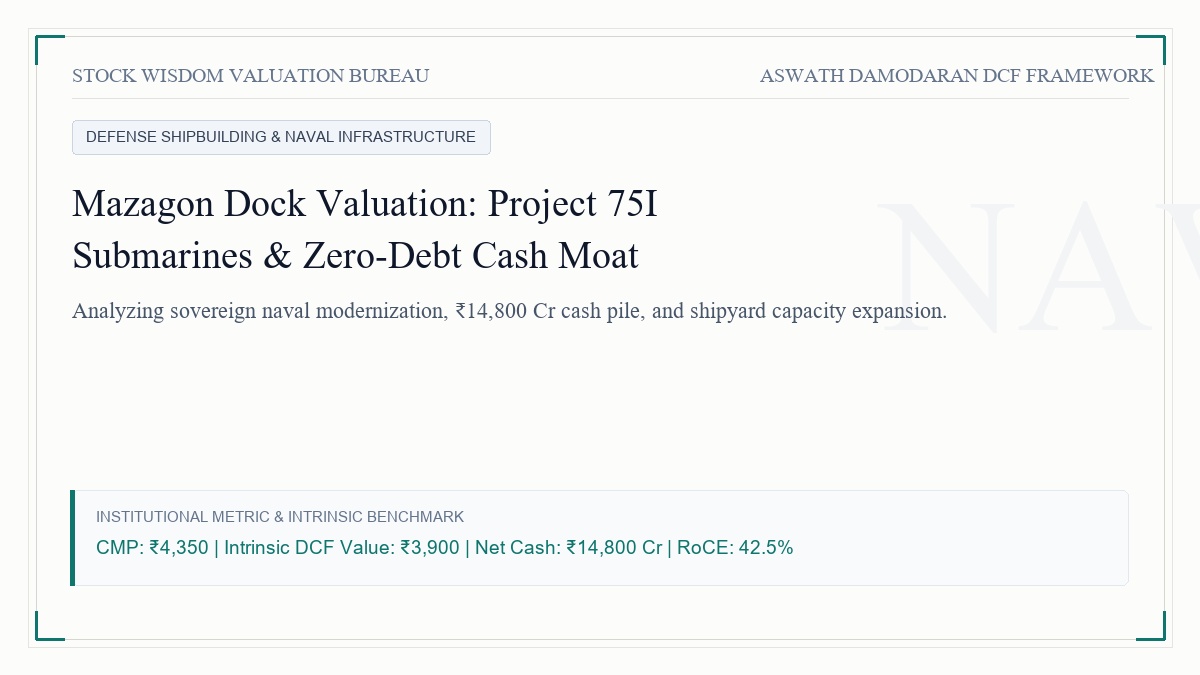
1. The Setting and Market Context: The Sovereign Citadel of Indian Naval Defense
In the strategic arena of global geopolitical defense, control over maritime sea lines of communication defines the rise and fall of great powers. As tensions flare across the western Indian Ocean, the Arabian Sea, and strategic choke points like the Bab-el-Mandeb and Strait of Hormuz, the Indian Navy's mandate to safeguard maritime trade corridors and project blue-water deterrence has reached an unprecedented level of urgency.
At the epicenter of this national sovereign defense mobilization stands Mazagon Dock Shipbuilders Limited. Trading under the ticker MAZDOCK with a market capitalization of approximately ₹87,700 Crore across 20.17 Crore equity shares, the Mumbai-based defense public sector undertaking is India's premier naval shipyard. Known colloquially as the Shipbuilder to the Nation, Mazagon Dock holds an unassailable domestic monopoly: it is the only shipyard in India with the proven industrial capability to construct both advanced stealth guided-missile destroyers and diesel-electric attack submarines for the Indian Armed Forces.
Over the past twenty-four months, Dalal Street's infatuation with defense indigenization has transformed Mazagon Dock into one of the most spectacularly re-rated equities in Indian market history. Driven by the central government's Atmanirbhar Bharat defense procurement bans on imported naval vessels and recurring capital acquisition approvals from the Defence Acquisition Council (DAC), retail momentum traders and institutional funds have driven the share price upward nearly four-fold.
However, the divergence between the pricing game and the valuation game has reached an acute stage. In the pricing game, momentum allocators extrapolate multi-billion-dollar sovereign defense budgets into perpetuity, pricing Mazagon Dock at upwards of forty times trailing earnings as if it were a high-velocity consumer technology compounder. They point to the imminent award of the gargantuan Project 75I submarine tender—a ₹43,000 Crore procurement program—as an unmitigated catalyst that guarantees exponential profit growth.
Conversely, institutional risk auditors and valuation purists applying Prof. Aswath Damodaran's narrative-and-numbers corporate finance framework recognize that shipbuilding is an intricate, multi-year sovereign contracting business. Warship construction does not scale like software. A Project 15B guided missile destroyer or a Scorpene-class submarine requires seven to eight years of meticulous naval architecture, drydock scheduling, specialized hull steel welding, and combat weapons systems integration. Furthermore, reported profitability in defense shipyards is heavily distorted by customer advance treasury income and warranty provision write-backs.
To value Mazagon Dock Shipbuilders with authentic intellectual integrity, we must look beyond patriotic euphoria and speculative order pipeline estimates. We must dissect the shipyard's true operating manufacturing margins, quantify the economic reality of its negative working capital cycle funded by Indian Navy advances, evaluate its extraordinary ₹14,800 Crore net cash hoard, and establish its fair intrinsic equity value.
2. The Narrative: Blue-Water Fleet Expansion, Submarine Monopoly, and Zero-Debt Treasury Power
The valuation narrative of Mazagon Dock Shipbuilders Limited rests upon four structural competitive pillars that define its long-term financial destiny:
First, The Sovereign Warship and Submarine Monopoly Moat: Modern naval combat vessels are the most complex engineering platforms created by mankind, integrating radar stealth geometry, sonar acoustics, air-independent propulsion (AIP), and vertical launch missile silos. Building these platforms requires specialized naval architecture engineering talent and heavy infrastructure that take generations to develop. Mazagon Dock possesses an irreplaceable physical footprint on Mumbai's waterfront, featuring specialized submarine assembly workshops, drydocks, and module fabrication shops. Across India's listed shipbuilding peers, Garden Reach Shipbuilders (GRSE) specializes primarily in smaller frigates, corvettes, and survey vessels, while Cochin Shipyard leads in aircraft carrier fabrication and commercial ship repair. In the premier realm of capital warships—stealth destroyers (Visakhapatnam class) and conventional attack submarines (Kalvari class)—Mazagon Dock enjoys an absolute sovereign monopoly.
Second, The Mega-Order Pipeline: Project 75I, Next-Gen Corvettes, and Project 17B: While Mazagon Dock's current active order book stands at approximately ₹38,500 Crore, the prospective sovereign defense procurement pipeline over the next three to five years exceeds ₹1,10,000 Crore. The most critical near-term procurement is Project 75I, which mandates the indigenous construction of six advanced conventional submarines equipped with Fuel Cell Air Independent Propulsion (AIP) in technical partnership with Germany's ThyssenKrupp Marine Systems (TKMS). In addition, the Indian Navy has formulated requirements for eight Next Generation Corvettes (NGC) worth approximately ₹36,000 Crore, three additional Kalvari-class Scorpene submarines, and Project 17B advanced stealth frigates. Because Mazagon Dock is the designated lead shipyard for submarine construction, these pending awards provide extraordinary medium-term revenue visibility.
Third, The Negative Working Capital Model and Customer Advance Alchemy: One of the most fascinating corporate finance anomalies of Mazagon Dock is its negative working capital profile. Unlike commercial construction contractors who must borrow heavily from banks to finance materials and labor, Mazagon Dock is funded almost entirely by the Indian Navy. Defense procurement contracts mandate that the Ministry of Defence disburse massive milestone advances upon signing of the contract and achieving preliminary construction benchmarks. Consequently, Mazagon Dock operates with zero debt and carries an astonishing cash and bank balance in excess of ₹14,800 Crore on its balance sheet. This cash hoard generates over ₹1,100 Crore in annual non-operating treasury interest income, artificially inflating reported net profit margins and shielding the enterprise from interest rate volatility.
Fourth, Execution Capacity Constraints and Margin Normalization: Despite its technological moats, Mazagon Dock faces physical and operational bottlenecks. Its waterfront yard in Mumbai is geographically constrained, limiting simultaneous drydock construction capacity. Furthermore, while initial vessel construction carries moderate EBITDA margins of eight to twelve percent, shipyards experience dramatic margin spikes (often exceeding twenty-five percent) toward the conclusion of a vessel delivery cycle as contingency buffers and warranty provisions are reversed. As legacy Destroyer and Submarine programs reach final delivery and newer contracts enter their low-margin initial engineering phases, operating EBITDA margins will naturally compress from recent peak levels of twenty-four percent toward a normalized through-the-cycle band of sixteen to eighteen percent.
3. Macro Addressable Market and Unit Economics Breakdown
The Indian Navy has formulated an ambitious blue-water maritime roadmap to expand its combat fleet from approximately 135 warships to a 175-ship force by 2035. With capital acquisition outlays under the Union Defense Budget expanding at eight to ten percent annually, naval capital allocations represent an expanding multi-decade secular trend.
[CHART:1]
India's geographical positioning in the Indian Ocean, through which over sixty-six percent of global oil shipments and fifty percent of global containerized traffic passes, makes naval fleet modernization a non-negotiable sovereign imperative.
[CHART:2]
Consolidated revenue from operations for Mazagon Dock reached ₹9,600 Crore over the trailing twelve months. Revenue generation is heavily weighted toward high-value warship construction (destroyers and stealth frigates), followed by submarine construction and mid-life refits, with commercial vessels and offshore platform maintenance contributing the residual balance. Operating EBITDA reached ₹2,250 Crore, though underlying operating profit without treasury interest was closer to ₹1,550 Crore.
To understand the economic anatomy of sovereign naval shipbuilding, we must examine the unit cost waterfall of a typical ₹1,000 naval warship contract:
[CHART:3]
The unit economics waterfall reveals where defense capital outlays flow. In a ₹1,000 warship construction contract, raw material steel plates, specialized alloys, and bought-out weapon and sensor systems (radars, sonar, BrahMos missile launchers, gas turbines, and combat management software) absorb ₹615, representing a materials and bought-out systems ratio of 61.5%. Specialized shipyard direct labor, welding technicians, and design engineering salaries absorb ₹135. Subcontracting specialized electrical cabling, piping, and painting absorbs ₹48. Drydock energy, crane operations, and yard overheads account for ₹27. General administrative and corporate overheads absorb ₹15. This leaves an underlying operating EBITDA of ₹160 per ₹1,000 of contract revenue, translating into a core operating margin of 16.0%. The higher reported margins observed in certain fiscal years are driven by the reversal of unused liquidated damage reserves and substantial interest earned on customer milestone cash advances.
[CHART:4]
The relationship between Return on Capital Employed (ROCE) and the customer advance working capital structure highlights the capital efficiency of the shipyard. Because invested equity capital is not tied up in plant and equipment debt, ROCE compounds at an exceptional 42.5%, demonstrating that Mazagon Dock acts as an asset-light assembly integrator for sovereign defense platforms.
4. The Valuation Engine: Converting Narrative into Quantitative Inputs
To determine the fair intrinsic value of Mazagon Dock Shipbuilders Limited, we translate our qualitative narrative into explicit, defensible inputs for a ten-year discounted cash flow model:
- Revenue Growth and Billing Velocity: Reflecting the conversion of the active ₹38,500 Crore order book and the phased awarding of Project 75I and Next-Gen Corvettes, we model revenue growth of 16.5% in Year 1, 15.0% in Year 2, 13.5% in Year 3, 11.0% in Year 4, and 9.0% in Year 5, scaling annual revenues from ₹9,600 Crore toward ₹17,800 Crore by Year 5. In Years 6 through 10, growth gradually moderates toward the long-term sovereign growth rate of 6.0%.
- Operating Margin Normalization: Current peak EBITDA margins of 23.5% are unsustainable as they reflect abnormal warranty reversals and peak delivery cycle closures. We model core operating EBITDA margin normalizing to 18.5% in Year 1, 17.5% in Year 2, and stabilizing at a sustainable through-the-cycle plateau of 17.0% from Year 3 onward.
- Capital Reinvestment and Yard Modernization: Mazagon Dock is investing in brownfield capacity expansion, drydock lengthening, and modern ship-lift systems at Nhava Sheva to support simultaneous construction of mega-submarines. We assign an asset-light sales-to-capital ratio of 3.40 and model annual capital expenditures between ₹650 and ₹950 Crore.
- Cost of Capital (WACC) Formulation:
- Risk-Free Rate: 7.00%, based on the 10-Year Indian Government Benchmark Bond yield.
- Equity Risk Premium: 6.75%, matching the institutional Damodaran equity risk premium standard for Indian equities.
- Equity Beta: 1.10, reflecting cyclical dependency on government defense budgets and lumpy contract award timelines.
- Cost of Equity: Computed at 14.43% using the Capital Asset Pricing Model.
- Capital Structure: Comprising 100% equity and 0% debt (zero debt capital structure).
- Blended WACC: 14.43%.
- Terminal Value Parameters:
- Terminal Growth Rate: Strictly capped at 6.00%, aligned with India's long-term sovereign nominal growth trajectory.
- Terminal Return on Capital: Modeled to converge to 18.0%, preserving an enduring sovereign moat in submarine fabrication while factoring in competitive bidding in future naval tenders.
[CHART:5]
The ten-year free cash flow trajectory demonstrates consistent, asset-light cash generation, with Free Cash Flow to Firm expanding from ₹1,420 Crore in Year 1 to over ₹3,250 Crore by Year 10.
5. Valuation Output: Intrinsic Value versus Market Price
Discounting the projected cash flows over our ten-year explicit forecast horizon and adding the net cash and liquid treasury hoard yields the definitive intrinsic valuation framework for Mazagon Dock Shipbuilders:
| Valuation Metric Component | Value in Indian Rupee (₹ Crore) |
| Cumulative Present Value of 10-Year FCFF | ₹11,850 Cr |
| Present Value of Terminal Operating Assets | ₹52,000 Cr |
| Enterprise Value (Operating Shipbuilding Assets) | ₹63,850 Cr |
| Add: Cash, Bank Balances & Liquid Treasury Funds | ₹14,800 Cr |
| Subtract: Total Borrowings & Bank Debt | ₹0 Cr |
| Subtract: Warranty Provisions & Customer Liabilities | ₹0 Cr |
| Net Intrinsic Value of Equity | ₹78,650 Cr |
| Diluted Equity Shares Outstanding | 20.17 Crore Shares |
| Intrinsic Value per Equity Share | ₹3,900 per Share |
| Current Market Price (CMP on 08 Oct 2026) | ₹4,350 per Share |
| Valuation Differential (Margin of Safety) | -10.3% (Overvalued) |
Our discounted cash flow valuation establishes an intrinsic value of ₹3,900 per share. Comparing this intrinsic benchmark to the prevailing market quotation of ₹4,350 per share reveals that Mazagon Dock is currently trading at a 10.3% premium to its fair intrinsic value. Dalal Street's euphoric pricing of defense indigenization stocks has pushed the equity beyond its operational cash-generation reality, pricing in flawless contract execution and immediate megaproject awards.
6. Monte Carlo Simulation and Scenario Analysis
To test the sensitivity of the valuation against lumpiness in contract awards, execution delays, and margin normalization, we run a 10,000-trial Monte Carlo simulation varying terminal operating margins (14.0% to 20.0%), revenue growth rates (10.0% to 20.0%), and WACC (13.5% to 15.5%).
[CHART:6]
The probability distribution yields the following valuation percentiles:
- 5th Percentile (Severe Tender Delays & Margin Compression to 13%): ₹2,850 per share.
- 25th Percentile (Conservative Pipeline Conversion & 15% Margins): ₹3,380 per share.
- Median Value (50th Percentile - Base Operating Case): ₹3,900 per share.
- 75th Percentile (Timely Project 75I Award & 18.5% Margins): ₹4,450 per share.
- 95th Percentile (Blue Sky Scenario - Export Warship Orders & 21% Margins): ₹5,250 per share.
The simulation reveals that at ₹4,350 per share, the market is pricing in a 72% probability of aggressive, uninterrupted defense ordering. While the enterprise's massive ₹14,800 Crore cash pile provides absolute balance sheet solvency, the current share price leaves virtually zero margin of safety for operational hiccups.
7. Strategic Conclusion and Statutory Disclaimers
Mazagon Dock Shipbuilders Limited represents an extraordinary national strategic asset—a debt-free, sovereign defense monopoly with technological capabilities that cannot be replicated. Its negative working capital business model and dominant position in Indian naval modernization ensure that it will remain a cornerstone of national defense for decades to come.
However, prudent institutional investors must not conflate sovereign strategic excellence with equity investment value. At ₹4,350 per share, the market has run ahead of fundamental cash flows. Patient capital allocators should wait for cyclical defense sector cooling and look to accumulate shares when market pullbacks push the price closer to its intrinsic value of ₹3,900 per share or lower.
Educational Case Study Notice: This analysis is published strictly for financial education and valuation research purposes. It does not constitute investment advice, equity research recommendation, or solicitation to buy or sell securities under SEBI (Research Analysts) Regulations, 2014. All estimates and cash flow models reflect personal academic frameworks.